
Therapies for Cellular Reprogramming
Antibiotic resistance, a global issue
We are developing a novel therapy that can simultaneously clear antimicrobial resistant (AMR) infections and promote wound healing.
Problem and Solution
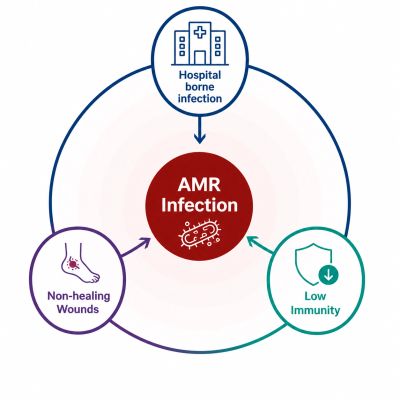
AMR - A global threat
Antibiotic resistance is an exploding problem worldwide, as many antibiotics are becoming ineffective to treat bacterial infections. Around 4.95 million deaths were associated with bacterial AMR in 2019 (4). In the absence of novel therapies, the AMR could kill 10 million people per year by 2050 (5).
Who is at risk?
As per an estimate, by 2050 death rate of AMR may surpass the deaths caused by cancer in today’s date. Unfortunately, efforts to develop new antimicrobials over the past two decades have been woefully behind the rapid evolution of pathogenic bacteria. It is observed that the incidents of AMR infections are higher in the population with weak immunity and exposure to healthcare associated infections. One such group is diabetic individuals.
Many low and middle income countries have high prevalence of type-II diabetes and India is considered as a diabetes capital of the world. About 50% of the elderly diabetics face non-healing wounds and skin infection in their lifetime. Such cases become very difficult to treat when last resort antibiotics fail to cease bacterial infections. Progressing ulcers and infections often result in limb amputation or death due to systemic spread.
How to solve it?
The combination of chronic non-healing ulcers and AMR infection is a complicated issue that requires a fundamental understanding of why diabetic skin cells fail to initiate wound healing and antimicrobial response.
Our in-house research has identified the molecular mechanisms behind why diabetic skin is more susceptible to skin infections and non-healing wounds.
With this knowledge, our therapy aims to restart the healthy wound-healing program in skin keratinocytes. Using our unique RNA interference technology, we activate the wound-healing program and antimicrobial response in skin keratinocytes. This helps achieve two goals: (1) pathogen clearance and (2) accelerated wound healing.
Transforming Medical Discoveries

The RiboKOSH platform
RiboKOSH is our ASO adn siRNA-based RNA interference platform. Rather than introducing an external antibiotic, it works by silencing a specific gene inside skin cells — releasing the cell's own antimicrobial peptide response and wound-healing programme.
Because the mechanism is the body's own innate defence rather than a foreign compound, it sidesteps the resistance-evolution problem that undermines conventional antibiotics.
The same platform is designed to be retargeted: change the siRNA sequence, address a different gene, and the delivery, formulation and manufacturing work carries across. This is what makes a single platform capable of supporting a pipeline across antimicrobial resistance,
chronic wounds and orphan skin disorders.
Platform ASO and siRNA design, lipid nanoparticle based delivery, topical formulation
Pipeline AMR infection, diabetic wound healing, orphan skin disorders
Network C-CAMP, inStem, NCBS, Shiv Nadar Institution of Eminence, industry partners
Team Founder-level command of the underlying discovery science

Where we are
· RNAi-inducible antimicrobial peptides cocktail discovered
· Efficacy validated in diabetic animal models and human skin explants
· Patents filed
· Preparing for IND application and Phase-I planning